Space is no longer just about rockets and astronauts on the moon. That is why the promotion of space technologies is part of our Technology Incubation project.We rely on space technology in our daily lives more than we realise – from navigation to banking operations to flood forecasting. 10% of Europe’s GDP depends on space activities. What role does the Czech Republic play in this area? How are startups applying space technology on Earth and why should we see investing in space as a smart move for national competitiveness? Tereza Kubicová, Deputy for Technology Development at the CzechInvest agency and co-founder of the Czech Space Week festival, spoke about more than just this in an interview with Roklen24.
What are currently the biggest challenges and opportunities for the Czech space industry?
There are a lot of challenges, but I prefer to talk about opportunities because I think it is important that people understand what is behind the word “space”. Space technology is not just satellites in orbit – it affects everyone’s daily life. Mobile phone navigation, ATM withdrawals, security systems or climate monitoring – all of these would not work without space.
In my opinion, there are extremely many opportunities, but we still have a lot of catching up to do compared to abroad. Increasing investment in space activities in the Czech Republic is a step in the right direction, but we are still not where we could be. That is why the Czech Space Journey project was created – a major strategic national project that aims to shield everything that is happening in space and to bring it closer to the public. Part of this project is the recruitment of the second Czech astronaut, Major Aleš Svoboda. The flight is expected to take place in 2027 or 2028.
How, specifically, does space technology improve the lives of ordinary people?
For example, the aforementioned navigation, without satellites you wouldn’t get anywhere in real time. And not only navigation constellations, but satellite Earth observation systems make our lives easier every day. Banking transactions, weather forecasts, traffic management (air and public transport) or responding to natural disasters – all are built on data from space. And then there are the less obvious applications. Memory foam, solar panels, wireless communication or miniaturising cameras into the form you have on your phone – these are products developed first for space use and then adopted on Earth. A nice Czech example is the bicycles from Festka, which used a carbon processing method developed for the fuel tanks of Ariane rockets to create extremely light, strong and durable frames.
What are the most promising areas of business in the space industry in the Czech Republic today?
We divide them into two branches – upstream and downstream. Upstream is what goes into space – materials, technology, instruments. This is an area with unlimited potential, especially in the context of the so-called New Space – a new era of commercial and more accessible space.
Downstream means using space data and technology here on Earth. I see huge opportunities here, for example in agriculture, transport, healthcare or energy. Both downstream and upstream have been on the rise in the Czech Republic over the last 10 years. I believe this is also thanks to our incubator ESA BIC Czech Republic.
How does the Czech Republic compare internationally?
The Czech Republic is basically the top. For example, all tantalum capacitors in orbit come from Lanškroun, Ariane 6 pieces are manufactured in Klatovy, and several Czech companies participated in the James Webb telescope. Our scientists and research facilities are part of elite projects such as Juice, Solar Orbiter, Lisa and others. Today we have over 200 companies and academic institutions actively involved in space. The number of startups is also growing – we have already supported more than 50 projects in the ESA BIC incubator.
In addition, thanks to the support of the Ministry of Transport, contributions to the European Space Agency (ESA) are being increased, allowing Czech companies to enter international projects. And these are not just about prestige – they are about real contracts, jobs and economic impact back to the Czech Republic.
Do you have concrete data on the return on investment in space?
Yes, we do. Previous analyses have shown that every public crown invested in a space startup, for example, is worth seventeen times the subsequent investment from the private sector. This is something that few industries can boast. When a startup receives ESA support, it opens the door to international markets, reaches investors who would otherwise be uninterested, and gains credibility, which is essential in this industry.
But the Czech Republic still struggles with the perception that space is just “expensive science fiction”. Why is this a problem?
Because space is a real business. It’s just not as visible as other sectors. Europe has ESA, but it doesn’t have Hollywood – so it doesn’t get made into movies like NASA. As a result, a lot of people see space as a distant and useless subject. But the reality is that training an astronaut, for example, means work for dozens of companies in the country. Development, testing, experiments, materials – all of this brings contracts, innovation and jobs.
Do you see a growing interest of investors in the Czech space sector?
Absolutely. Besides the fact that several large European aerospace corporations (e.g. SAB Aerospace or OHB) have their branches and R&D centres in the Czech Republic, Czech companies and startups are starting to be visible on the international map. Some already have offices abroad, establishing partnerships with NATO or global agencies. Companies like Dronetag or Spacemanic prove that the Czech space industry is not small. And what is key – investors are beginning to understand this.
How should the approach to space in the Czech Republic change if we want to be competitive?
We need to stop seeing space as a fad and start seeing it as a real strategic sector. It is a way to strengthen our economy, innovation and position in Europe. Most importantly, we need to explain it to the public. It is not about PR. It is about being a country in five or ten years’ time that is not just leading the way, but actively setting the direction.
The program will feature investor conferences, demo days, pitching sessions for investors, matchmaking and networking, expert lectures and workshops, as well as events focused on defense and dual-use technologies.
From among the 50 startups that entered, the jury selected 12 finalists. Meet the companies that will compete for the audience’s favor and prizes from the competition’s partners on October 20 at the OX Club in…
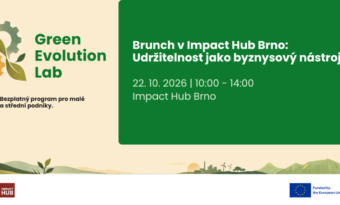
How can sustainability help companies win new contracts, reduce costs, and boost their competitiveness? That will be the topic of the next workshop in the Green Evolution Lab series.
The event takes place on October 20 at Prague’s OX Club, welcoming over 500 participants from Czechia and abroad. Join us to connect with key players in the tech ecosystem and explore new opportunities.