Every day, millions of people face the risk of cardiac arrhythmias, which often go undetected for a long time. The startup Kardi Ai Technologies has developed a smart system for long-term ECG monitoring, thank to which patients can have an overview of their heart health in the course of their everyday lives and doctors can obtain accurate information for faster and more reliable diagnoses. Technology Incubation supported the startup’s transition from the development phase to commercialisation and assisted with the preparation of its technology for international expansion.
Heart disease, particularly arrhythmia, ranks among the leading causes of death and often goes undetected for a lengthy period of time. The shortage of cardiologists and the limited effectiveness of conventional methods, such as 24-hour EKG monitoring and occasional check-ups with a doctor, make timely diagnosis significantly more difficult. The consequences of that are profound: in Europe alone, approximately 1.8 million people die of cardiovascular disease every year, including roughly 30,000 in Czechia. The necessity of preventing such deaths led to the development of the Kardi Ai technology.
From Personal Experience to a Technological Solution
The idea behind Kardi Ai arose from the personal experiences of its founders, Prof. MUDr. Tomáš Skála, Ph.D., FESC,a cardiologist who daily sees how difficult it is to detect brief episodes of arrhythmia, and Stephen Burke, a patient who has faced a similar problem himself. “We wanted to develop a solution that would enable long-term heart monitoring in a patient’s everyday life and provide doctors with high-quality data for more accurate diagnoses,” say Vlastimil Hrabal, CEO of Kardi Ai. This idea became the basis of a story that gradually grew into a robust medical technology.
A Technology that Detects Even the Quietest Arrhythmias
The technological principle of the service is straightforward: the user wears a chest strap that continuously records an EKG signal, which is subsequently sent to a mobile app, where it is analysed by AI algorithms. The system is able to quickly detect a broad range of arrhythmias and warn of a potential risk, often within a few minutes of completing the measurement. Thanks to this, the patient receives timely information on their condition and the doctor has accurate data available for determining the subsequent course of action. Within a few minutes after measuring has been completed, the system generates a summary report that is comprehensible for both the patient and their attending physician.
The technology is designed in such a way that it is usable in the course of everyday life, i.e. when the patient is working, exercising and relaxing. “Such long-term monitoring in a real-world environment significantly increases the chance of detecting even irregular episodes of arrhythmia, which a brief in-office examination would easily miss. Therefore, the patient does not have to wait for their next check-up and the doctor gets a more comprehensive picture of how the patient’s heart actually functions in everyday situations,” Hrabal explains. It is during these situations that irregular episodes often appear and are thus not detectable using standard methods.
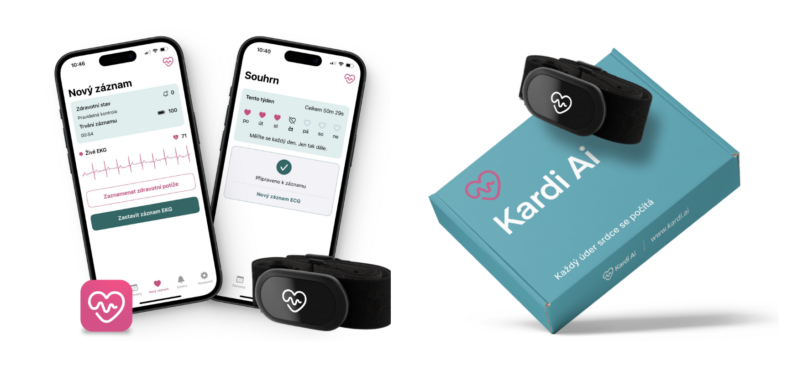
The Kardi Ai app and chest strap.
Between Innovation and Regulation: The First Major Obstacles
Like many other MedTech companies at an early stage of development, the Kardi Ai team had to reconcile rapid technological development with the strict requirements of the healthcare environment. Cutting corners is unforgivable in the MedTech sector. Everything depends on clinical precision, clear record-keeping and fulfilment of regulatory requirements, which are extraordinarily stringent in Europe. “One of the biggest challenges was to reconcile technological development with the requirements of the healthcare sector, which is heavily regulated and demands a high level of clinical validation,”Hrabal adds.
In addition to developing the technology itself, the team also had to prepare the process for obtaining medical-device certification in accordance with the European Union Medical Device Regulation (MDR). This involves a clinical study, extensive regulatory documentation and an audit by a notified body. These steps ordinarily take months of intensive work and require a large financial outlay. “Obtaining MDR certification is extremely difficult. It is a major burden for a small team in terms of both time and funding, so I greatly appreciate what the Kardi Ai team has managed to achieve,” says Hrabal.
From a technological perspective, the team then faced another major challenge: to create AI algorithms that would be capable of reliably analysing EKG signals in the course of users’ everyday lives, i.e. not only in an examination room, but also while exercising, walking, sleeping or under stress. The real world is more complicated for AI than the controlled conditions of a clinic. Therefore, it was necessary to create a solution that works effectively where conventional methods fail.
Technology Incubation Helped Prepare the Product for Market
When the team entered Technology Incubation, it was faced with some critical steps: completion of the development of new product functionalities, preparation for clinical validation of the technology and preparation of the product for commercialisation and scaling. “The support provided by Technology Incubation helped us to accelerate some of the crucial regulatory and development activities associated with preparing the product for market,” says Hrabal.
“In the case of Kardi Ai, It was obvious from the beginning that it wasn’t only about the technology, but about solutions that would have a real impact on healthcare. Technology Incubation helped with structuring the startup’s further development so that it could succeed in the demanding regulatory environment and concurrently establish a strong position for entering foreign markets,” adds Blanka Szurmanová, the project’s incubation manager.
Technology Incubation provided significant support to Kardi Ai, as it helped the startup to accelerate certain critical steps associated with the certification of an MDR Class IIa medical device, thanks to which doctors can use the system’s outputs when making diagnoses. “The programme’s support helped us to push the product’s development forward and prepare it for commercial scaling,” Hrabal explains. In addition to technological advancement, procedural and strategic decision-making were also important aspects of incubation. “It was clear that Kardi Ai possessed great determination and a powerful vision. At the same time, however, this was a very complex project involving both technology and medicine. Incubation offered the team the opportunity to consult with experts on the product’s further development and to continually verify their technological and strategic decisions,”adds Szurmanová.The acquired certification and completed development have lain a solid foundation for further growth. “Observing Kardi Ai in the course of incubation was interesting mainly with respect to how quickly they managed to advance not only the technology, but also their overall approach to the product and its introduction to the market. The programme created a space for expert consultation and the sharing of experience, while the team continued to develop the product and prepare for the next phase of growth,”the incubation manager says.
The result is a fully certified MDR Class IIa medical device, one of only a few of its kind in the world. Vlastimil Hrabal adds: “The support provided by Technology Incubation has helped us to accelerate Kardi Ai’s technological development and carry out certain key activities sooner than we would have been able to do using only our own resources. Thanks to the programme, we were able to invest in the development of advanced functionalities, improvement of the system’s robustness and preparation of the product for further scaling and expansion abroad.”
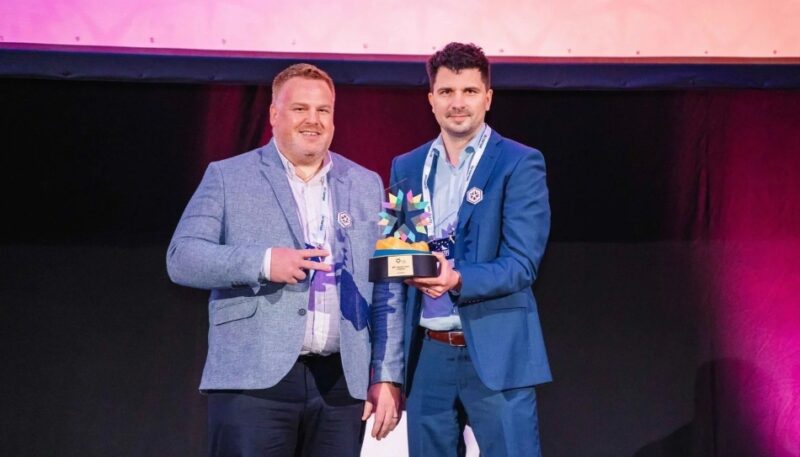
Kardi Ai co-founders Vlastimil Hrabal and Pavel Digaňa accept the grand prize at the 2026 Global Startup Awards for winning the Best HealthTech Startup category.
Hundreds of Lives Saved, International Successes, and a Path to Global Markets
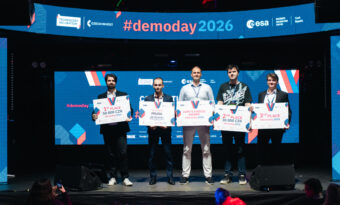
Kardi Ai ranks among the fastest-growing companies in the area of digital cardiology. Its system has already helped to detect hundreds of serious arrythmias and has thus contributed to saving more than 350 lives. The technology has over 4,500 registered users and the startup collaborates with more than 180 cardiologists and sixty hospitals in the Czech Republic. The cost of using the system is covered by two health-insurance companies. To date, the startup has gained investments in the total value of more than EUR 3 million, while reporting year-on-year revenue growth of more than 80%. The success of Kardi Ai’s development has been confirmed by a number of major awards, the most significant of which include its victory in the worldwide final of the Global Startup Awards 2026 in the Best HealthTech Startup category. Kardi Ai was the first Czech startup to ever win this competition, overcoming more than 70,000 other startups from 154 countries. The company also found success in the Central European Startup Awards, was ranked among the Impact Stars in the Deloitte Technology Fast 50 CE competition, was named one of the top fifty projects by the Health Tech World association, and took first place in the Vodafone Idea of the Year competition. It also achieved a significant milestone in connection with Technology Incubation, where it won first place in the Technology Incubation #demoday competition.
Kardi Ai is now entering the phase of international expansion. The startup is actively preparing to enter markets in Europe, India, Singapore and the Middle East. Following its planned Series A investment round, the company intends to significantly accelerate its growth and gradually build local teams that will support business development and collaboration with hospitals.European MDR certification is critical in order to ensure that the technology can be used not only in Europe, but also in other regions. “Our ambition is to make prevention of heart disease available to the general public. We want long-term heart monitoring to be a standard part of care that is simple, safe and available to everyone,” says Vlastimil Hrabal, adding: “Thanks to Technology Incubation, we were able to accelerate the development and commercialisation of Kardi Ai. The programme’s support helped us to prepare the technology for further growth and international expansion, thanks to which our solution can help more people detect serious cardiovascular disorders in a timely manner.”
The program will feature investor conferences, demo days, pitching sessions for investors, matchmaking and networking, expert lectures and workshops, as well as events focused on defense and dual-use technologies.
From among the 50 startups that entered, the jury selected 12 finalists. Meet the companies that will compete for the audience’s favor and prizes from the competition’s partners on October 20 at the OX Club in…
How can sustainability help companies win new contracts, reduce costs, and boost their competitiveness? That will be the topic of the next workshop in the Green Evolution Lab series.
The event takes place on October 20 at Prague’s OX Club, welcoming over 500 participants from Czechia and abroad. Join us to connect with key players in the tech ecosystem and explore new opportunities.